24H After Sale Service Center
Wechat: EXCITECH-SUPPORT1
Which Palletizing Robot Is Better?#Which Palletizing Robot Is Better# In panel furniture workshops, palletizing is an often-underestimated process. Unlike nesting, which directly determines panel dimensions, or edgebanding, which visibly affects the appearance of finished products, unstable pallet stacks and disorderly placement will trigger problems in subsequent transfer, stacking and panel turning. Collisions on panel edges and scratches on panel surfaces are frequently not caused during machining, but occur silently in palletizing and handling. Many factories classify such losses as "normal wastage". In fact, from another perspective, the root cause usually lies in the selection of palletizing equipment.
When evaluating whether a palletizing robot is worth adopting, first check if it handles panels gently. Decorative panels used in custom furniture have delicate surfaces. Rough gripping and impact during placing will leave marks on panels. The real difference does not lie in the robot’s payload capacity, but whether the whole system understands panel characteristics. Secure gripping, gentle placing and neat stacking define ideal performance for panel processing scenarios. Going further, palletizing systems serve mixed-order production lines. Cabinet panels, door panels and workpieces of varying thicknesses are nested together with inconsistent sizes. A single stacking logic cannot fit all cases. Whether the system can identify panels of different sizes and work out a proper placement sequence to stack large and small panels in staggered, stable layers directly decides stack stability and whether frequent rework occurs in later manual or automated transfer. Messy stacks are rarely due to careless workers; instead, the equipment lacks palletizing logic tailored for panel materials. Q1: Is a higher payload always better for palletizing robots?A: No. Most panels in panel processing are thin flat sheets. The priority is whether the gripping method fits the panel surface and whether movements stay smooth. Excessive payload redundancy will unnecessarily raise system costs. Secure gripping and gentle placing are the core priorities. Q2: I already have a nesting machine. Can the palletizing robot connect with it smoothly?A: It depends on signal integration and cycle time synchronization. Self-developed robots from the original manufacturer are usually well adapted to the discharge rhythm of its own nesting cell for seamless connection. Third-party solutions often require repeated on-site debugging of communication protocols. Q3: Is stack pattern planning really that important?A: Very important. Proper stack patterns reduce panel shifting and transfer collisions while improving stack stability. Disordered stacking wastes space and requires frequent sorting in downstream processes, slowing down overall production.
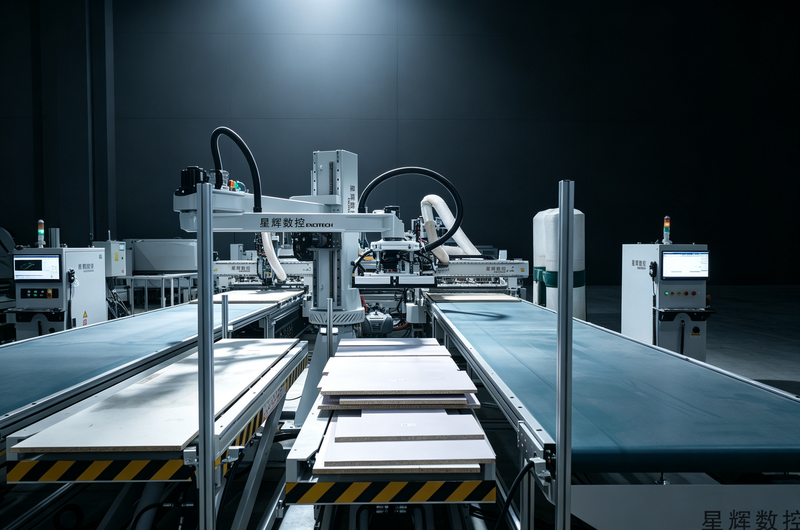
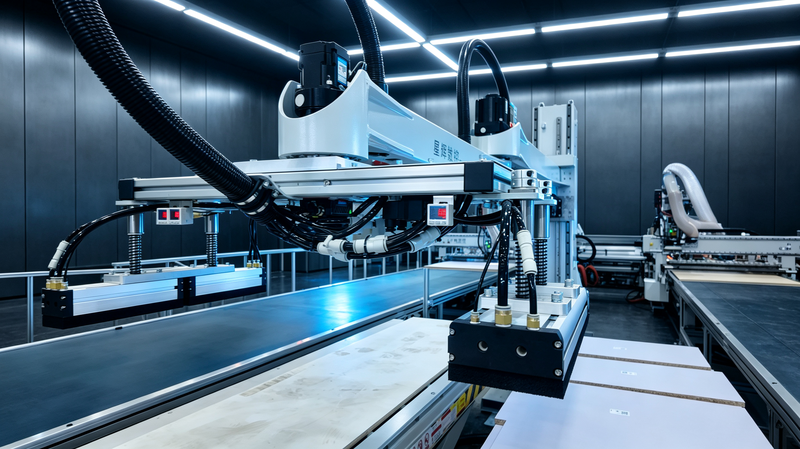
The stability of palletizing largely determines how much workload is reduced for frontline workers. Neat stacks enable easy forklift transfer and smooth panel turning. Chaotic stacks force workers to rearrange panels repeatedly and work overtime for rework, offsetting the labour savings brought by automation. This explains why some factories fail to gain expected efficiency gains even after robot deployment: the equipment only moves panels from one spot to another without fundamentally solving stack pattern issues. Built exclusively for panel nesting and palletizing working conditions, the 4-axis nesting palletizing robot from EXCITECH is independently developed and manufactured by EXCITECH. The whole system integrates self-developed vision recognition modules and palletizing algorithms, specially designed for gripping and stacking mixed panels discharged after nesting. The vision module identifies workpieces of different specifications and automatically compensates for position deviations. The built-in palletizing algorithm calculates proper placement sequences and stack patterns to arrange large and small panels in orderly layers, lowering the risk of edge chipping and surface scratches. Its 4-axis structure suits flat panel handling, with a compact footprint for easy integration into existing workshops. It can link with EXCITECH nesting cell to perform automatic palletizing after nesting, ideal for whole-house custom factories running mixed production of various panel types. #Palletizing Robot #Panel Furniture Palletizing #Nesting Palletizing Robot #Whole-house Custom Automation #EXCITECH |